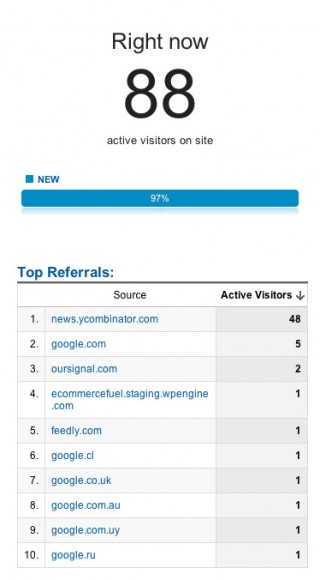
When the blog post Andrew Youderian, of eCommerceFuel, wrote about being targeted by a patent troll hit the front page of Hacker News, his site got a flood of traffic.
Andrew’s post benefitted/suffered from the “Hacker News Effect.” The HackerNews Effect is what happens when a blog post hits the front page of HackerNews. An intense bout of traffic arrives from HackerNews to the linked content and tests the mettle of your servers.
This is awesome if your servers can scale, because it means new visitors. If your servers can’t scale the new visitors will bring the page down entirely.
At the zenith of eCommerceFuel’s traffic, real-time analytics showed between 80-100 concurrent connections. That afternoon thousands of unique visitors stopped by in a four-hour timespan.
During the deluge of traffic, Andrew’s site on WP Engine stayed responsive to each visitor.
Because he was so happy with the performance of his site, Andrew sent us some of the data about how well his site scaled and we asked if we could write a blog post about it.
Andrew told us that he was afraid his previous hosting wouldn’t be able to dynamically scale with traffic spikes, so he came over to WP Engine.
“I either had to run the risk of an overloaded server during a spike, or pay for more resources than I used on average in order to be prepared.”
Andrew also hosted two eCommerce sites on the server, both of which would slow down severely if he received a spike in blog traffic.
As well, since the server was shared, a single WordPress hack would compromise both eCommerce sites.
“I decided to try you out with your promises of dynamic scalability, speed, and WordPress expertise.”
When his post went viral on HackerNews, WP Engine got the chance to live up to its marketing.
“Despite the deluge of traffic, my site was as snappy and responsive as ever. Pages loaded quickly and if I hadn’t been watching my analytics, I would have never known the server was experiencing a large spike. Your servers handled the load beautifully.”
Traffic to your WordPress site can unexpectedly spike to incredible levels when the right content is shared on a big outlet. Since these spikes always happen by surprise, and it’s impossible to react quickly to them. The only way to be prepared is to have servers that are ready to scale when the moment arrives.
“On my old server, the spike alongside my normal traffic would have crippled the blog and my eCommerce sites, costing me lost revenue and potential readers….I’m thrilled I migrated my WordPress blog to WPEngine. I’ll be recommending you to others!”
But like LeVar Burton always said, you don’t have to take our word for it. See for yourself how our technology can handle huge traffic spikes by examining our infrastructure.
Congratulations to your post hitting the HN frontpage.
One thing I’d like to add is that the “number of active users” google analytics displays is in a time-frame of several minutes. (the screenshot is obviously taken from google analytics)
I have not found out how long exactly it is but when a little tool I created gut lots of publicity for about a day it peaked at ~140 current users according to google analytics. When I looked at the data afterwards it turned out that it was about 2.800 visitors and almost 20.000 pageviews that day.
If all that traffic would have been in 10 hours and before and afterwards would have been no traffic at all, this would be ~33 pageviews per minute, which is easily handled by slow shared hostings (like mine 🙂 too.
That just to put the numbers into perspective.
Anyway, it’s awesome to be on the frontpage of hacker news and it’s awesome to use specialized hosting providers.